
Flow of Funds
Purchase and redemption — where money moves, and where it does not
1. Purpose
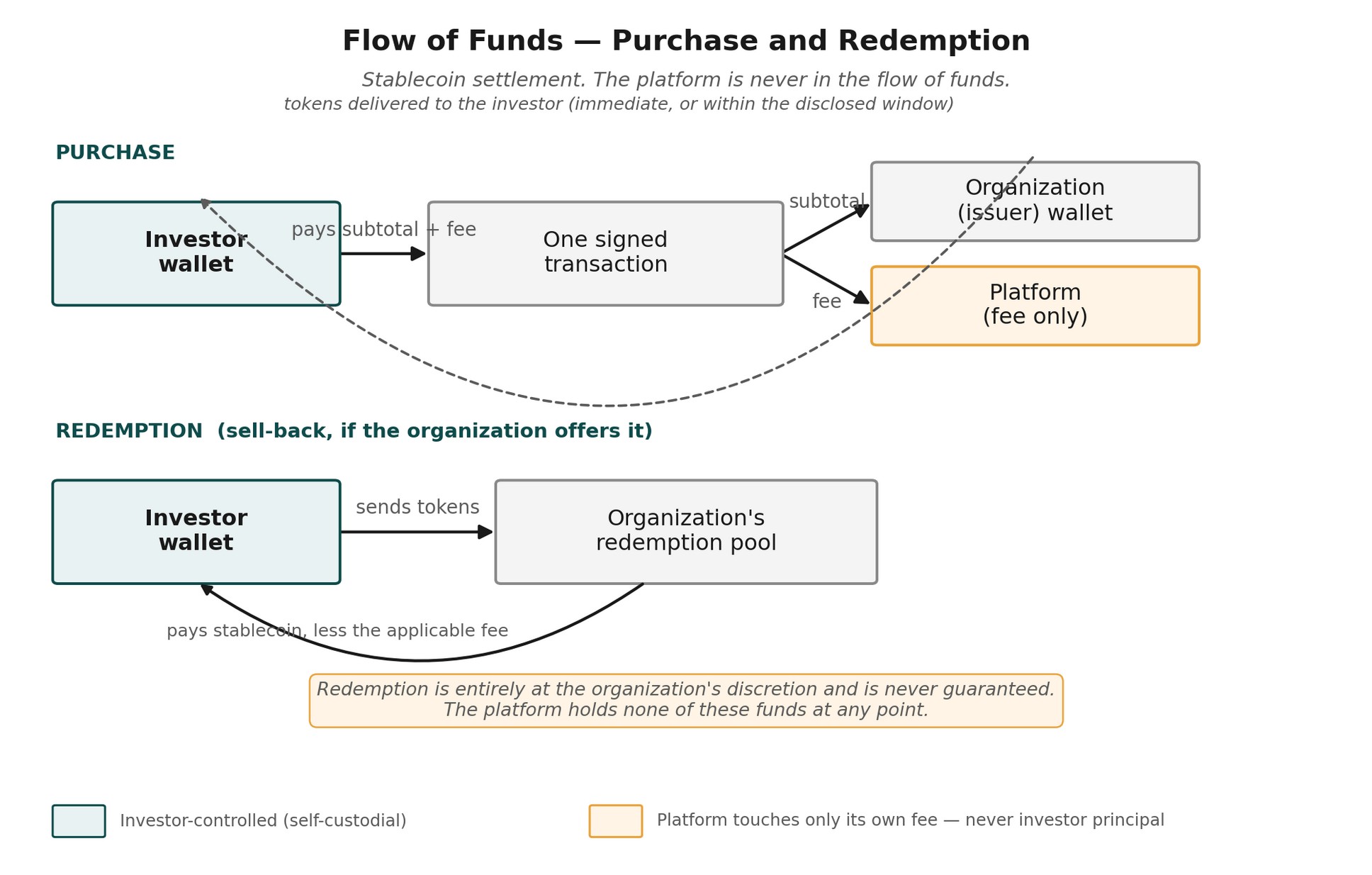
This document shows, in diagram form, exactly where money moves when an investor purchases or redeems a security on the platform, and confirms that the platform is not a party to that movement of principal at any point.
2. Reading the Diagram
Purchase
An investor authorizes a single on-chain transaction. That one transaction carries two outputs: the subtotal, which is sent to the organization's wallet, and the platform fee (if applicable), which is sent to a platform-controlled address. Both transfers occur atomically as part of the same transaction — there is no intermediate step in which funds are held by the platform pending further action.
Delivery of the tokens purchased follows on the schedule applicable to that instrument type: immediately and atomically with payment for SAFE and fund tokens, or within a delivery window for equity tokens where the organization does not hold pre-existing inventory. The issuing organization sets the length of that window for its specific offering, up to a maximum of sixty days, and it is disclosed to the investor before purchase.
Redemption
Where an organization has elected to make a redemption facility available, an investor sends tokens directly to that organization's redemption pool and receives stablecoin directly from that same pool, net of the applicable fee. The platform is not a party to this transaction and does not hold the pool's funds.
Redemption is never guaranteed. It depends entirely on the organization electing to offer it and maintaining sufficient balance in its pool. An investor should not assume a means of exit exists.
3. What This Confirms
- Investor principal moves in a single step directly to the party the investor intends to pay.
- The platform's only receipt of funds, in any transaction, is its own disclosed fee — never investor principal.
- No step in either flow requires funds to be held by, or pass through an account controlled by, the platform.
This document describes the flow of funds for on-platform investment transactions specifically. It does not describe the fiat-to-stablecoin on-ramp process, which is provided by independent third-party providers and is outside the platform's control.