
Investment Transaction Flow
From eligibility check to a settled position
1. Purpose
This document sets out the sequence of checks and steps that occur between an investor deciding to invest and that investment settling as a recorded position. It is the operational detail underlying the Flow of Funds document.
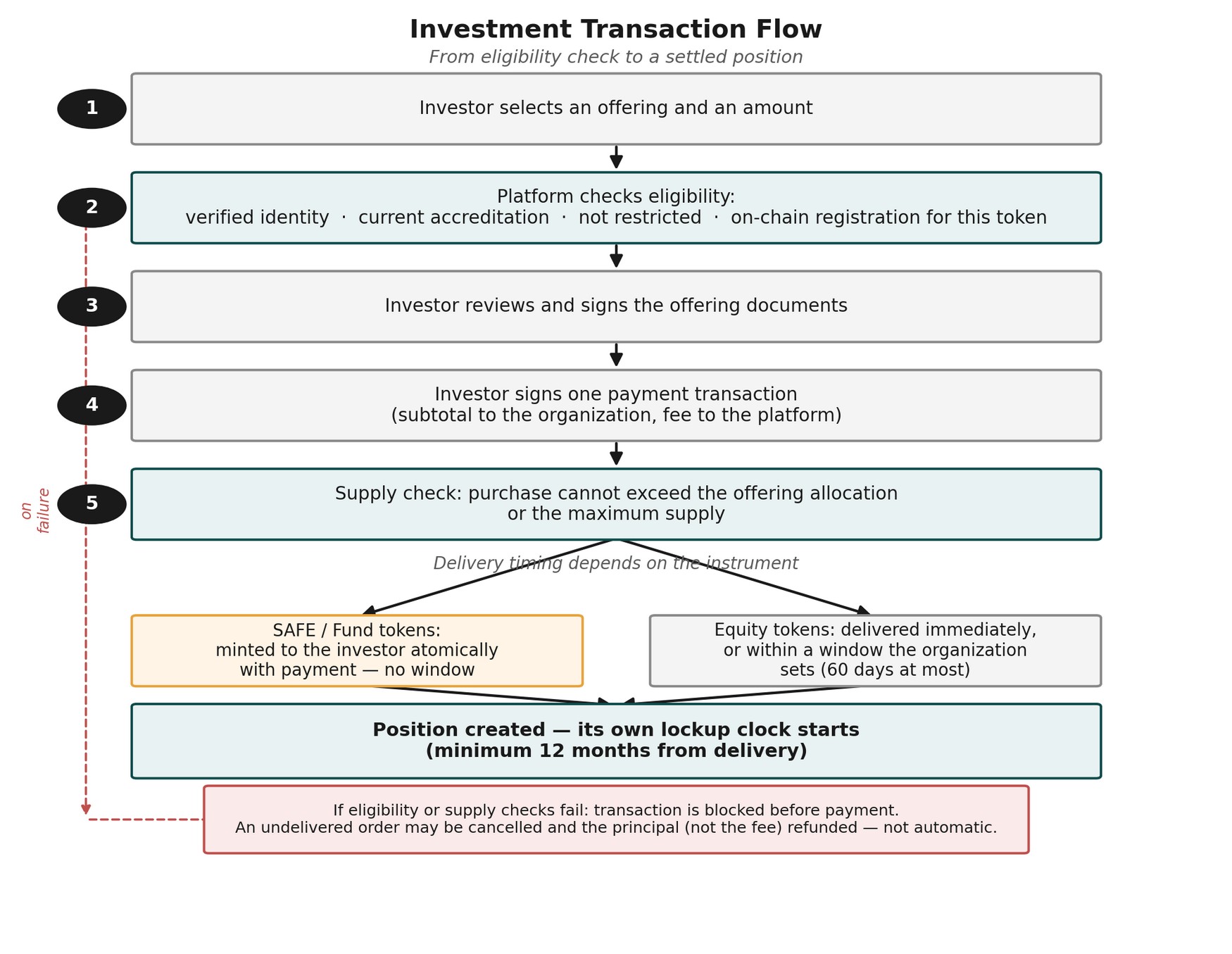
2. Step Detail
| Step | Detail |
|---|---|
| 1 | The investor selects a listed offering and specifies an amount, subject to any minimum or maximum investment set by the organization. |
| 2 | The platform evaluates eligibility before any payment is requested: the investor's identity verification and accreditation must be current, the investor must not be subject to a platform-wide restriction, and the investor must be registered on-chain for the specific token being purchased. |
| 3 | The investor is presented with, and must affirmatively acknowledge and sign, the offering's governing documents. |
| 4 | The investor signs a single payment transaction, settling as described in the Flow of Funds document. |
| 5 | The platform confirms the purchase does not exceed either the amount the organization has made available in this offering or the maximum supply the instrument may ever reach. |
3. Delivery Timing
Delivery timing is determined by the instrument type and is disclosed to the investor before purchase:
- SAFE and fund tokens: minted directly to the investor atomically with payment. There is no delivery window because no off-chain step is required to issue the instrument.
- Equity tokens: delivered immediately where the organization holds available inventory, or within a delivery window where issuance requires an off-chain step on the organization's part. The organization sets the length of that window for its specific offering, up to a maximum of sixty days, and it is disclosed to the investor as part of that offering.
4. On Settlement
Once tokens are delivered, the platform records a position for that specific acquisition. Each acquisition is tracked as its own position, restricted from transfer for a minimum of twelve months from the date of delivery, rather than as an addition to a single running balance. This twelve-month restriction reflects the minimum holding period contemplated by Regulation D for restricted securities of this kind; an organization may set a longer restriction period for its own offering, but not a shorter one.
5. Failure Handling
Two distinct failure modes are handled differently, and deliberately so:
- A failed check (eligibility or supply) blocks the transaction before any payment is requested. No funds move and no reversal is required.
- An equity purchase that remains undelivered may be cancelled by the platform, refunding the investor's principal at the price recorded when the order was placed. This is an administrative action available to the platform, rather than an automatic outcome triggered by the passage of time. See the Refund and Cancellation Policy for full detail, including the treatment of the platform's fee in this circumstance.
This document describes the primary-market purchase flow. Peer-to-peer secondary trading is not enabled on the platform at this time.